October 15, 2026
Fast is better than slow.
We've got two new PhoneLLM models optimized for conversational voice AI.
PhoneLLM Mini (30B) — When you need the lowest possible latency (sub-100ms TTFAT), smallest model size, and lowest cost. Good multi-turn conversation behavior and tool-calling accuracy in a model that can run >100 concurrent agents on a B200 and fits on an RTX 5090.
PhoneLLM Max (120B) — A "microthinking" model for complex conversational tasks. Sub-200ms TTFAT. SOTA task completion performance at 1/10th the latency and cost of models with similar capabilities.
Both of these models are full-weights fine-tunes of @NVIDIAAI Nemotron models. Mini is based on Nemotron 3 Nano. Max is based on the brand new Nemotron 3.5 Super VL.
Both of these models are available as open weights on HuggingFace, and from four inference partners: AWS, Baseten, Cloudflare, and Modal.
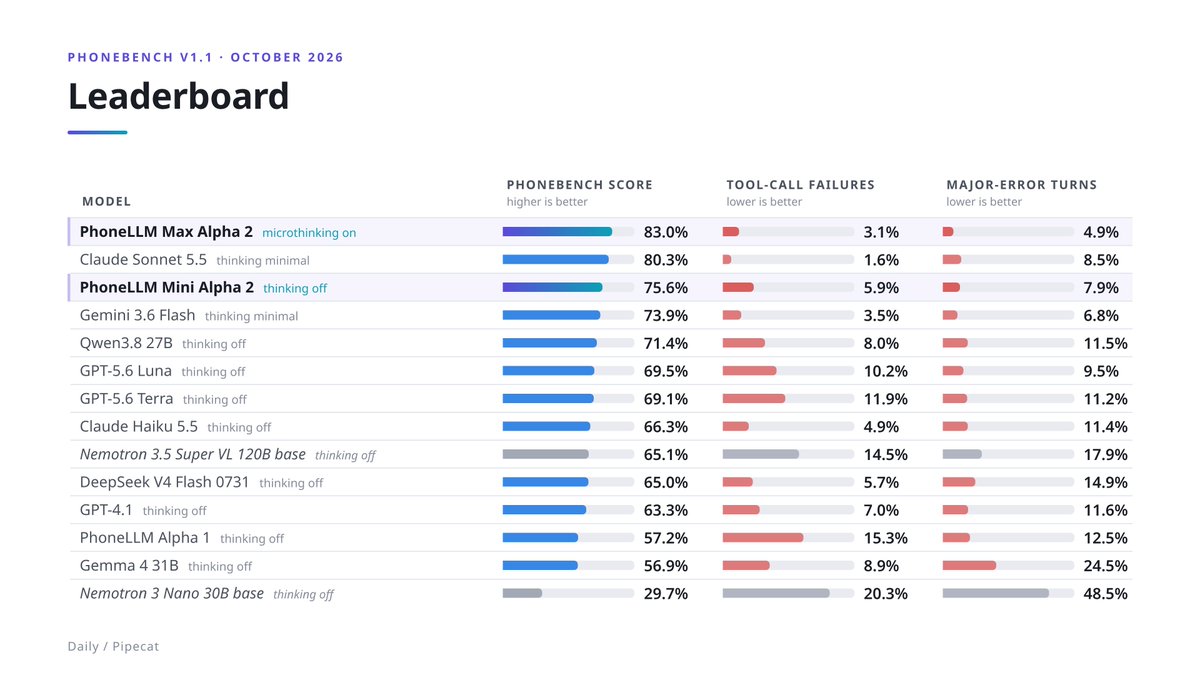
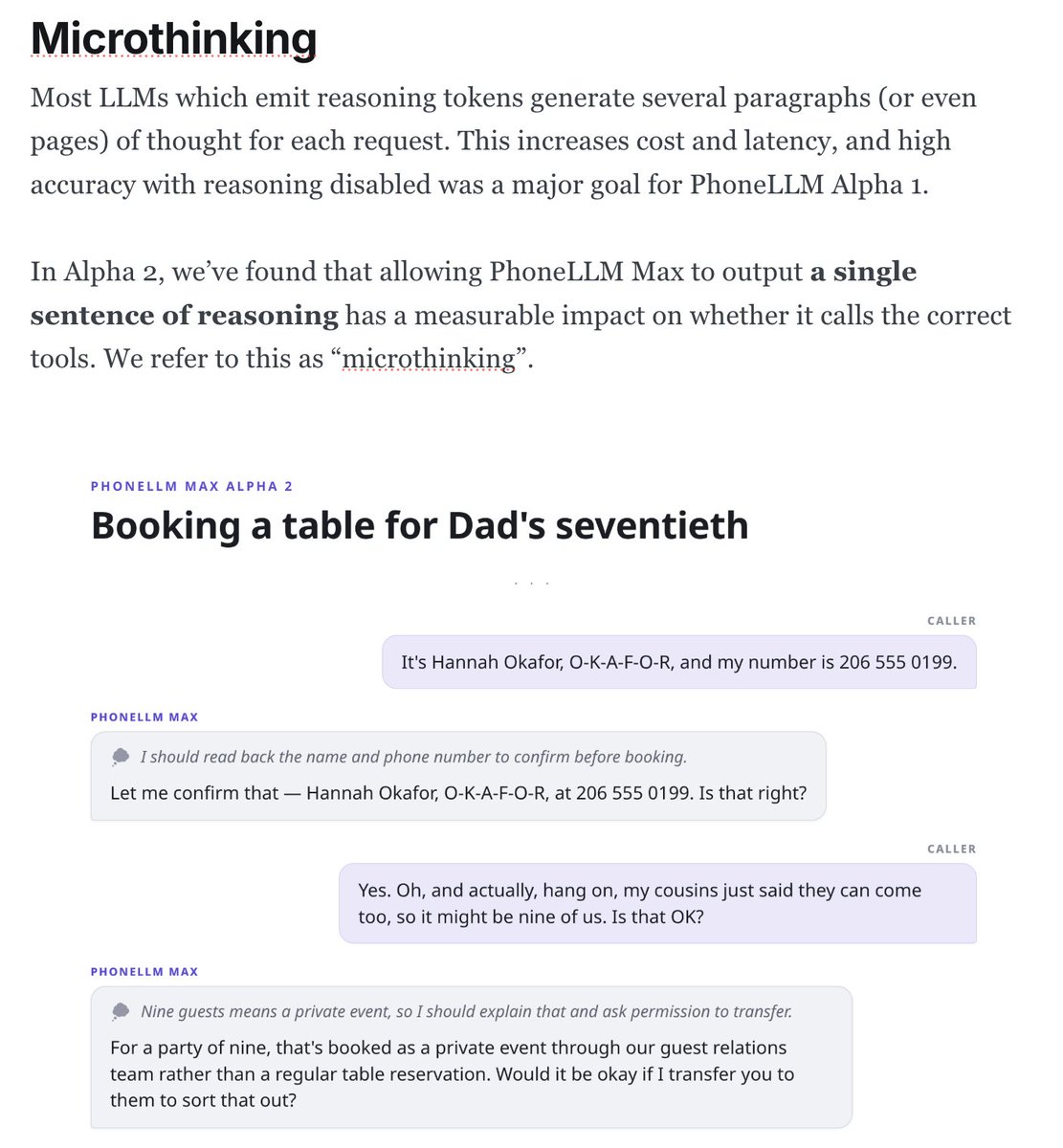
PhoneLLM Max introduces "microthinking." Most LLMs today emit dozens (or hundreds) of reasoning tokens for each request. Even models that support low thinking modes typically generate too many reasoning tokens for the models to be useful as voice conversation front ends.
We trained PhoneLLM Max to output a single sentence of reasoning. This small amount of reasoning has a measurable impact on whether the model calls the correct tools and follows instructions accurately.
The model is quite fast, both in time to first token and token throughput. So the single reasoning token adds about 100ms to the "time to first answer token" metric that is of critical importance for voice agents. This is not nothing, but compared to the ~1,500ms TTFAT numbers you'll see from other models with similar performance, it's a good trade-off.
We kept PhoneLLM Mini a non-reasoning model. We've done a lot of experimentation and found that we like being able to choose between a small, ultra-fast model and a bigger, still very very very fast model. They definitely have somewhat different personalities and capabilities. Both are useful.
For both Mini and Max, we focused on improving the following things in this release:
More flexible prompting. Small models are harder to prompt than big models. They are more literal, they have more corner cases, they are more sensitive to small variations in prompting. Both Mini and Max are easier to write prompts for than the Alpha 1 model we released last month.
More task shapes. The "sweet spot" use cases for these models are the conversation shapes we see in typical enterprise voice agents: customer support, calling to remind people about appointments, scheduling and reservations, looking up information. We've expanded the conversation types in the training data set substantially. These are still models that are designed first and foremost for the agents we spend our time helping customers deploy into production, but they're also pretty good at new use cases like being the voice front end for complex software programs.
Pipecat Flows support. Pipecat flows is a widely used library for voice agent workflows. Complex voice agent tasks need to be implemented as state machines. This keeps prompts compact and focused on accomplishing specific sub-tasks. State machine agents have measurably higher success rates than big, single-prompt agents. We built Pipecat Flows metrics into the PhoneBench eval framework that is the heart of the training pipeline for these models.
Here's our launch blog post, with more details and links to partner endpoints and weights on HuggingFace.
PhoneLLM deployment pages on @Baseten:
PhoneLLM Mini Workers AI API endpoint on @Cloudflare:
@Cloudflare PhoneLLM in your workspace on Modal:
Mini -[5]
Max -[6]