January 16, 2026
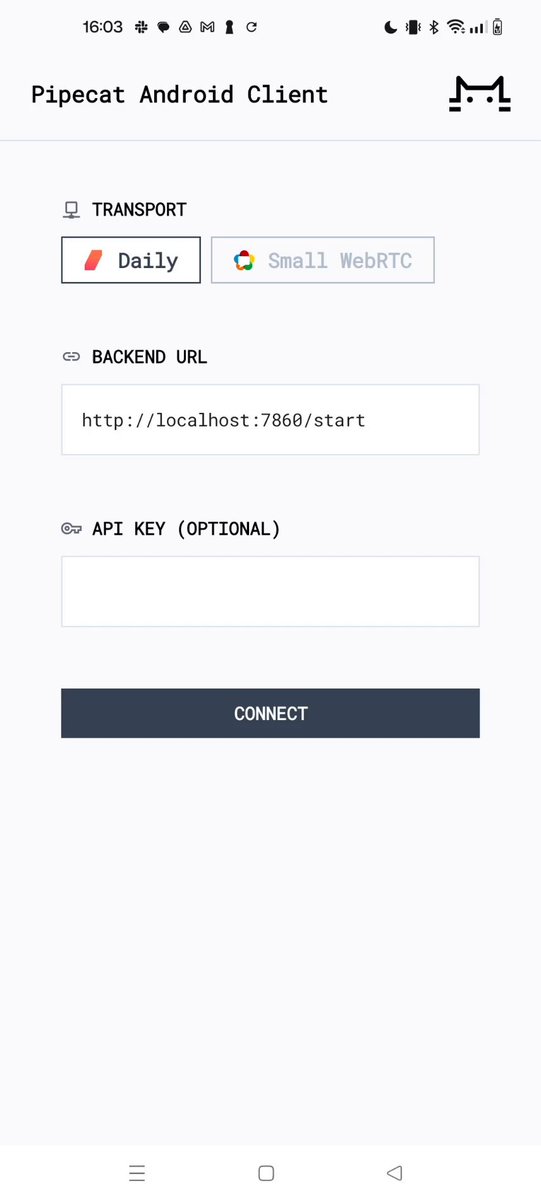
If you're getting started with voice agents and Android, the Pipecat Android demo client has all the core components a client-side voice AI app needs: voice input and output, device control, and network transport.
Marcus just updated the code, which now supports two WebRTC transports. The Pipecat SmallWebRTCTransport for zero-dependency, peer-to-peer connections. And the Daily WebRTC transport for large-scale production use.
The demo bot also sends a video stream, which the app renders.
You can actually use this code to connect to any voice AI service that implements the RTVI standard, too, not just Pipecat. The Pipecat client-side SDKs (Javascript, React, React Native, Swift, Kotlin, and C++) are part of the Pipecat ecosystem but don't depend on any server-side Pipecat components and are completely open source.
Pipecat Android demo client[1]
Pipecat Simple Chatbot example (for the client to connect to). Two flavors of bot are provided: gpt-4o and Gemini Live. But you can modify the bot to use any TTS, LLM, STT, or speech-to-speech model[2]