June 27, 2025
Pipecat Flows is a context engineering library for voice agents.
Today's LLMs are *great* at two things: natural, open-ended conversation; and extracting structured data from unstructured input.
They are not great (yet) at reliably following detailed instructions throughout a multi-turn conversation.
Complex voice workflows like healthcare patient intake and user research interviews require that specific actions happen during a session. (Sometimes in a specific order.)
Today, for reliable instruction following across multiple conversation turns, you need to dynamically compress and summarize the conversation history periodically. The idea is to make the context shorter and focused on the currently relevant subset of workflow actions. Doing this properly has a big impact on conversation success rates.
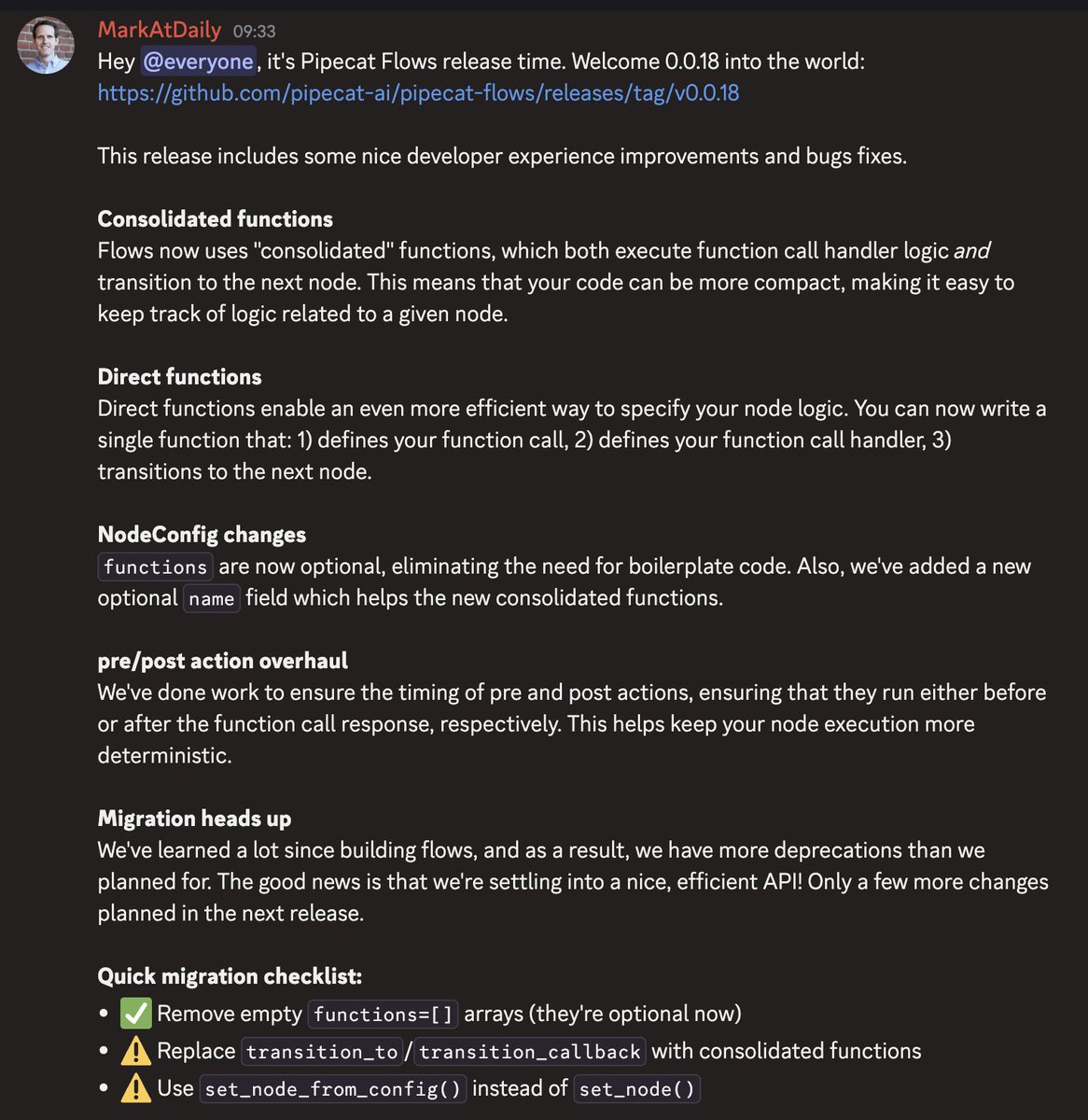
Here are the brand new Pipecat Flows 0.0.18 release notes.
The core Pipecat Flows abstraction is the conversation node. Think of a node as consisting of:
- a system instruction
- a transformed version of the conversation history
- a tools list
- available exit transitions to other nodes
A conversation workflow is a collection of node definitions. You can design conversations as either a static path of nodes, or dynamic paths that are determined at runtime.
Pipecat Flows is open source and works with any LLM API that supports updating system context and tools mid-session.
https://t.co/tRtSVtyrtr