 Taranjeet@taranjeetio
April 23, 2025
I've played around quote a bit with voice + memory.
You can build your own long-term conversational agent with @pipecat_ai and @mem0ai in about 75 lines of Python code.
I have a todo list agent that I use and constantly tinker with. It's on my todo list to clean that code up to post publicly. :-)
I'll put a link to another nice single-file starting point in reply, though ...
Taranjeet@taranjeetio🔊 Build low-latency voice agents powered by memory via @mem0ai
🎙️ Real-time voice input
🧠 Memory-enriched context
🗣️ Instant, human-like replies
Create agents that listen, recall, and respond like they truly know your users - built with @pipecat_ai + @OpenAI + Mem0
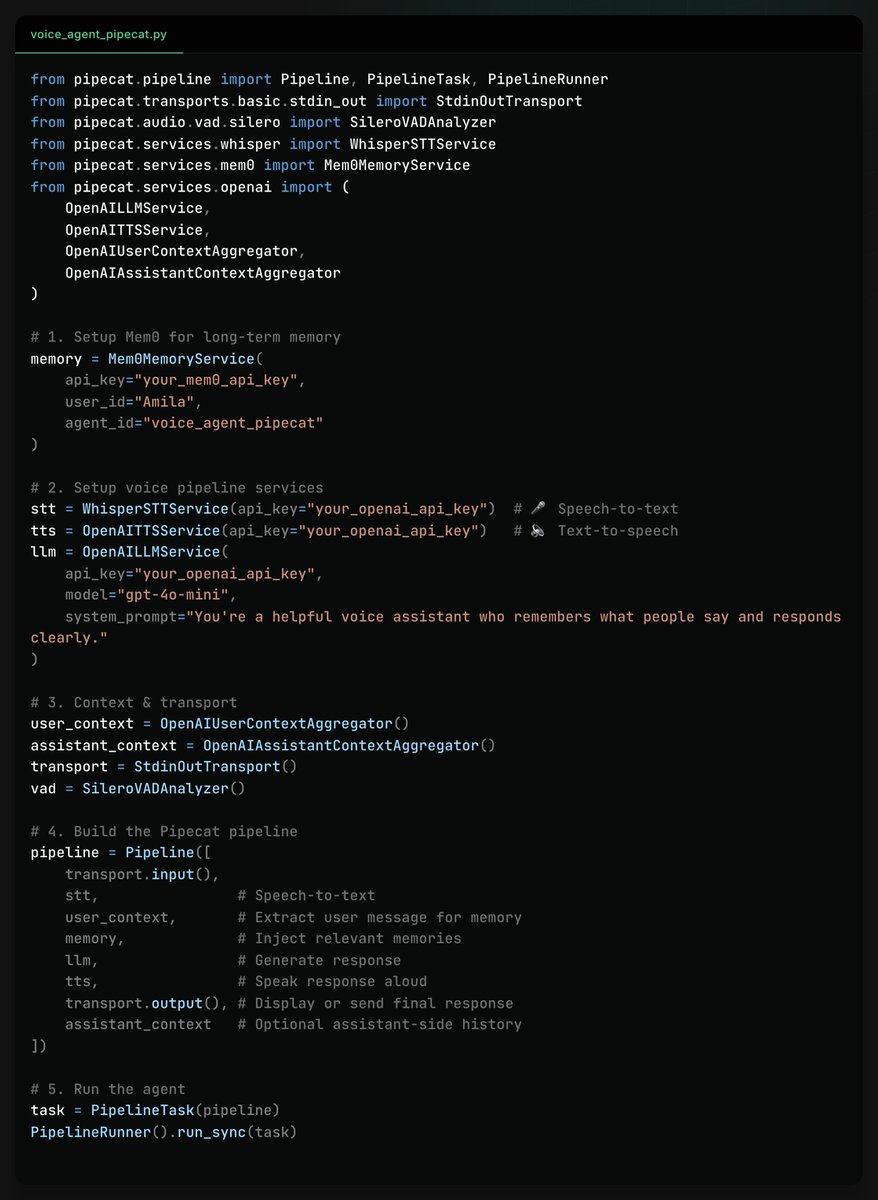
Here's the mem0 single-file example in the Pipecat repo:
https://t.co/Mt1WH4I53M
This uses @mem0ai, @OpenAI, @DeepgramAI, and @elevenlabsio. You can change a few lines of code to swap out any of these services, or even run a local LLM.
Ignore the comments about needing a Daily API key. The example now uses the serverless WebRTC transport that comes with Pipecat (`SmallWebRTCTransport`). So you can run the voice agent on your computer and connect to it from a local client, or from your phone, or deploy it to the cloud as a private voice AI sandbox.
(I'll make a PR to update the comments in the example!)